How to Create a Slide In Popup in WordPress (Step-by-Step Guide)

Most visitors leave a website without subscribing, purchasing, or taking any action. Whether you run a WooCommerce store, SaaS platform, business website, blog, or landing page, losing potential customers and leads can directly impact your conversions and revenue.
This is why many WordPress website owners use Slide In Popups to engage visitors without disrupting their browsing experience.
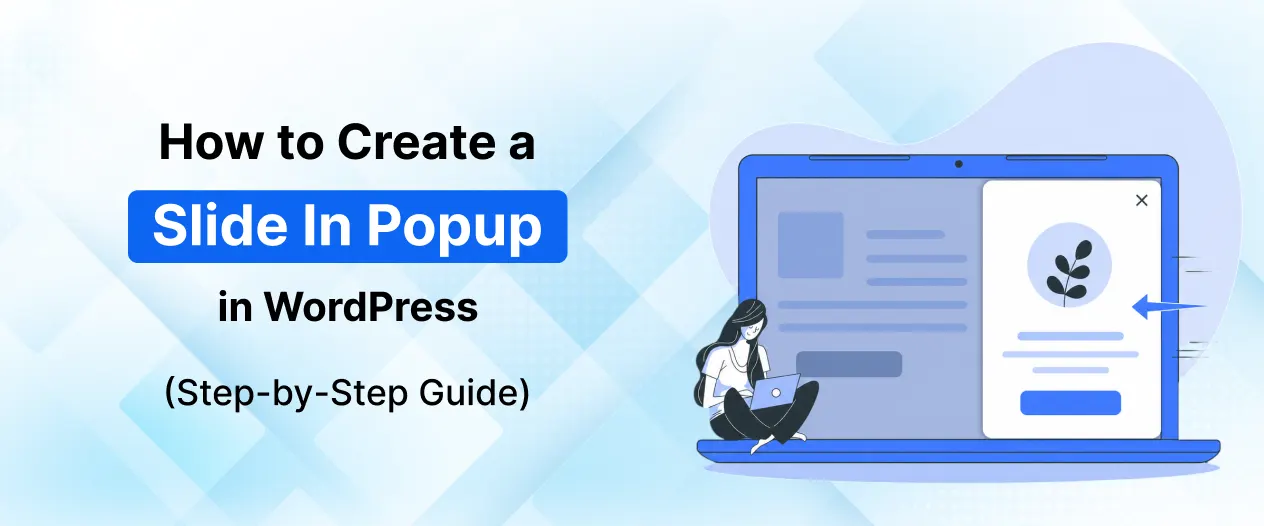
A Slide In Popup is a subtle, non-intrusive popup that slides into view from the corner or side of the screen while a visitor is browsing your webpage. Instead of blocking the entire screen, it gently nudges visitors to take action using:
- Discount offers
- Coupon codes
- Newsletter signup forms
- Lead magnets
- Countdown timers
- Promotional campaigns
Today, Slide In Popups are widely used to:
- Increase email subscribers
- Reduce bounce rates
- Improve lead generation
- Engage visitors without interrupting their experience
- Boost website conversion rates
The best part is that you can create a Slide In Popup in WordPress without coding knowledge.
Using popup builder plugins like YS LeadGen, you can easily create professional slide-in popups with ready-made templates, countdown timer blocks, responsive designs, smart display rules, and advanced triggers.
Whether your goal is to:
- Grow your email list
- Increase WooCommerce sales
- Generate more leads
- Improve customer engagement
- Promote time-sensitive offers
Slide In Popups can become one of the most effective conversion optimization tools for your WordPress website.
In this step-by-step beginner guide, you’ll learn:
- What a Slide In Popup is
- Why Slide In Popups are important
- How to create a Slide In Popup in WordPress
- Best practices for higher popup conversions
- Common mistakes to avoid
By the end of this tutorial, you’ll be able to create high-converting Slide In Popups that help turn passive visitors into subscribers, leads, and customers.
What is a Slide In Popup?
A Slide In Popup is a website popup that smoothly slides into view from the bottom corner or side of the screen while a visitor browses a webpage.
Unlike traditional full-screen popups that block page content, Slide In Popups are designed to be less intrusive. They appear unobtrusively while visitors continue reading or scrolling, making them a popular choice for:
- Newsletter signups
- Discount offers
- Countdown timer promotions
- Lead generation forms
- Limited-time deal alerts
This popup style is widely used by WordPress websites, WooCommerce stores, SaaS businesses, blogs, and online businesses to improve website conversions without hurting user experience.
How Slide In Popups Work
Slide In Popups are triggered based on specific visitor behaviors on a webpage.
When the defined condition is met, the popup smoothly animates into view — typically sliding in from the bottom-right corner of the screen.
The popup may include:
- Discount offers
- Coupon codes
- Newsletter signup forms
- Countdown timers
- Free trials
- Lead magnets
- Promotional messages
Because the popup slides in without blocking the main content, visitors can choose to interact with it or continue browsing — making the experience feel natural rather than forced.
This improves both:
- User experience
- Conversion opportunities
Why Businesses Use Slide In Popups
Most website visitors leave without:
- Purchasing a product
- Subscribing to updates
- Filling out forms
- Contacting the business
Without a Slide In Popup, those visitors may leave without engaging with your offers.
Businesses use Slide In Popups to:
- Increase email subscribers
- Promote time-limited offers with countdown timers
- Recover abandoning visitors
- Generate more leads
- Improve WooCommerce sales
- Boost website conversion rates
For example:
- An eCommerce website may show a discount countdown popup during a flash sale
- A SaaS website may offer a free trial popup to scrolling visitors
- A blog may display a newsletter signup form after a user reads an article
Showing the right message at the right time can significantly improve visitor engagement and conversions.
Common Types of Slide In Popups
Different businesses use different popup strategies depending on their goals.
Popular Slide In Popup types include:
- Discount Popups
- Newsletter Signup Popups
- Countdown Timer Popups
- Cart Recovery Popups
- Free Trial Popups
- Lead Generation Popups
- Promotional Offer Popups
Each popup type is designed to encourage visitors to take action while they are still engaged with your content.
Benefits of Slide In Popups
Slide In Popups have become one of the most effective and user-friendly conversion optimization tools for modern WordPress websites.
Instead of interrupting the browsing experience, Slide In Popups appear gently alongside page content — giving website owners a non-intrusive way to capture leads, promote offers, and improve visitor engagement.
Whether you run a WooCommerce store, SaaS platform, business website, agency site, or blog, Slide In Popups can help improve your overall website conversion strategy.
Here are some of the biggest benefits of using Slide In Popups on your WordPress website.
1. Increase Email Subscribers
Building an email list is important for long-term business growth.
However, many visitors leave websites without subscribing to newsletters or updates. Slide In Popups help capture visitor emails at the right moment by offering incentives such as:
- Discount coupons
- Free resources
- Exclusive deals
- Weekly newsletters
Example:
“Subscribe Now & Get 10% OFF on Your First Order.”
This helps businesses grow their email subscribers and improve future marketing opportunities through email campaigns.
2. Promote Time-Sensitive Offers with Countdown Timers
One of the most powerful features of Slide In Popups is the ability to add a countdown timer directly inside the popup.
Countdown timers create urgency and encourage visitors to act before time runs out. This is especially effective for:
- Flash sales
- Limited-time discount offers
- Product launch promotions
- Seasonal campaigns
Example:
“Hurry! This Offer Expires In:” [Countdown Timer]
Combining a Slide In Popup with a countdown timer can significantly improve conversion rates for time-sensitive promotions.
3. Reduce Bounce Rates
Bounce rates indicate how many visitors leave without interacting with your website.
Slide In Popups help engage visitors by displaying relevant offers or content just as they are about to lose interest. This encourages users to:
- Subscribe to updates
- Explore a special offer
- Continue browsing more pages
A well-timed Slide In Popup can improve session duration and reduce bounce rates.
4. Improve Website Conversion Rates
Driving traffic to a website is expensive and time-consuming.
Instead of focusing only on getting more traffic, businesses should also focus on converting existing visitors into:
- Customers
- Subscribers
- Leads
Slide In Popups improve website conversion rates by presenting a relevant offer without completely interrupting the browsing experience.
Even a small increase in conversions can generate significant business growth over time.
5. Generate More Leads
Lead generation is essential for businesses like:
- Agencies
- SaaS companies
- Service providers
- Consultants
Slide In Popups can help collect:
- Email addresses
- Contact inquiries
- Demo requests
- Consultation bookings
This helps businesses capture qualified leads even while visitors are actively browsing the website.
6. Promote Offers Without Disrupting User Experience
Traditional full-screen popups often block the entire page and can frustrate visitors.
Slide In Popups appear only in a corner of the screen, making them:
- Less intrusive
- More elegant
- Better for user experience
Businesses can use them to promote:
- Seasonal discounts
- Flash sales
- Product launches
- Free trials
- Webinar registrations
Displaying offers without blocking content significantly improves the balance between engagement and user experience.
7. Easy to Create in WordPress
One of the biggest advantages of modern WordPress popup plugins is simplicity.
Using tools like YS LeadGen, website owners can create professional Slide In Popups without coding knowledge.
You can:
- Choose popup templates
- Customize popup designs
- Add countdown timer blocks
- Enable scroll-based or time-based triggers
- Configure display rules
- Publish popups within minutes
This makes Slide In Popup marketing accessible even for beginners.
How to Create a Slide In Popup in WordPress
Creating a Slide In Popup in WordPress is much easier than most beginners think.
With the help of modern WordPress popup builder plugins, you can create professional and high-converting Slide In Popups without coding knowledge or technical experience.
In this tutorial, we’ll use YS LeadGen to create a Slide In Popup step-by-step.
Whether your goal is to:
- Increase email subscribers
- Promote time-limited offers with countdown timers
- Generate more leads
- Reduce bounce rates
- Recover abandoning visitors
this guide will help you set up your popup in just a few minutes.
Step 1 – Install the Slide In Popup Plugin
The first step is installing a WordPress popup plugin that supports Slide In Popup functionality.
- Login to your WordPress dashboard.
- From the left sidebar, navigate to: Plugins → Add New Plugin
- In the search bar, search for: YS LeadGen
- Click Install Now, Click Activate
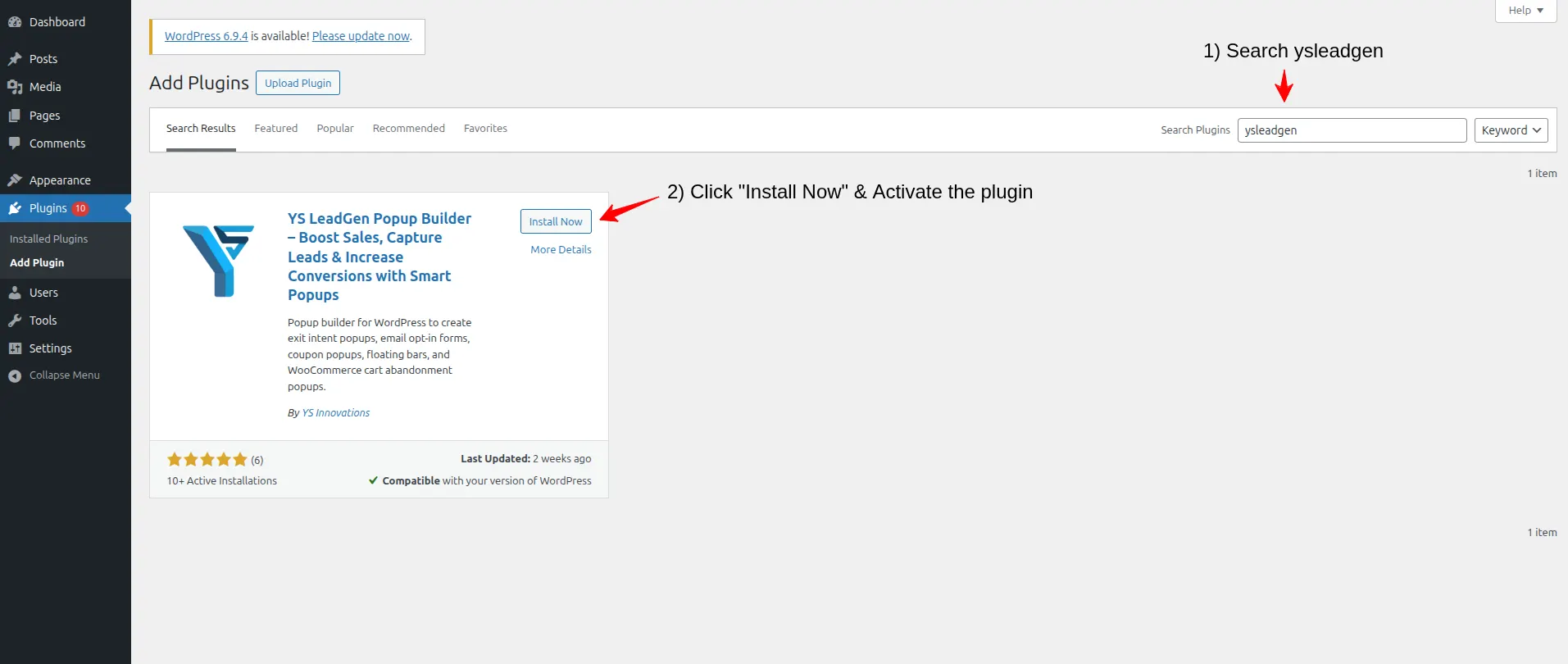
After activating the plugin, you’ll see the YS LeadGen menu added to your WordPress dashboard.
Using a beginner-friendly popup plugin simplifies the entire popup creation process and helps you launch campaigns faster.
Why Installing the Right Popup Plugin Matters
Not all popup plugins offer professional Slide In Popup functionality.
A good popup builder should provide:
- Slide In Popup display options
- Countdown timer blocks
- Responsive popup designs
- Smart display rules
- Conversion-focused templates
- Easy customization options
YS LeadGen is designed specifically to help WordPress website owners create professional lead generation and Slide In Popups easily.
Step 2 – Create a New Popup Campaign
After installing the plugin, the next step is creating your popup campaign.
- Go to: YS LeadGen → New Campaign
- Click: Create a Popup
- Now enter a name for your campaign.
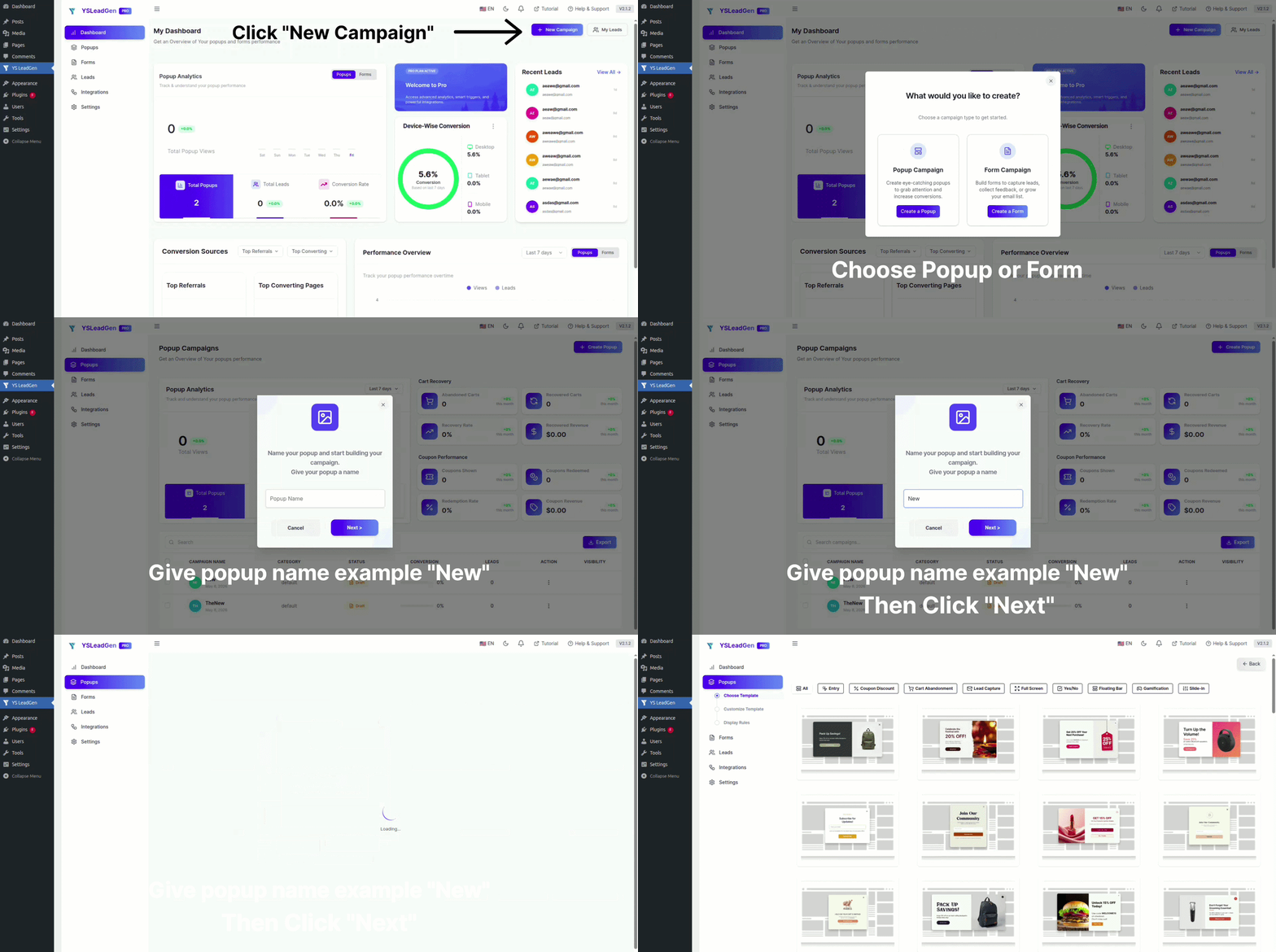
Example campaign names:
- Slide In Discount Popup
- Newsletter Signup Popup
- Countdown Timer Promotion Popup
- Flash Sale Slide In Popup
Using clear campaign names helps organize and manage multiple popup campaigns more efficiently in the future.
Why Campaign Structure is Important
Many businesses run multiple popup campaigns simultaneously for:
- Homepage promotions
- Blog lead generation
- WooCommerce discounts
- Seasonal offers
- Email subscriptions
Creating separate popup campaigns helps improve targeting and conversion optimization.
Step 3 – Choose a Popup Template
Now it’s time to choose how you want to design your Slide In Popup.
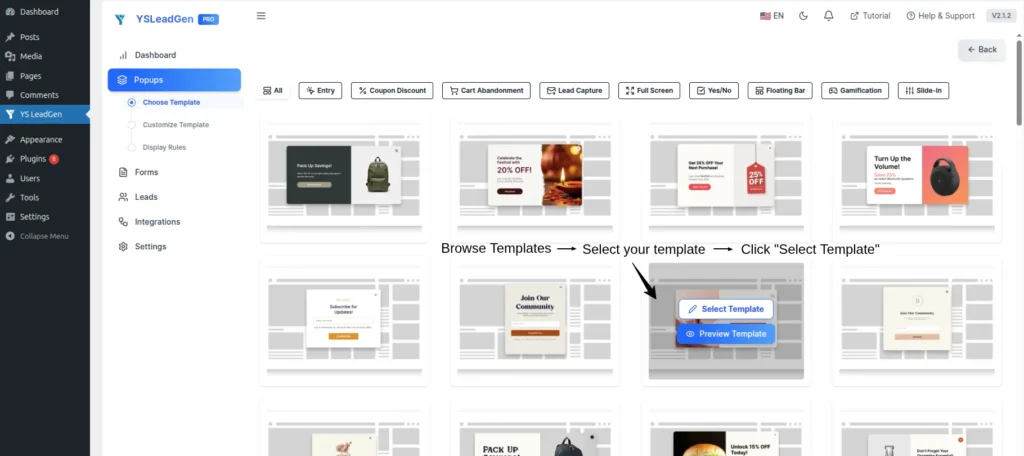
Select the template and click on the select template button.
These templates are specifically designed for:
- Flash sales
- Limited-time discount offers
- Seasonal promotions
- Product launch campaigns
Simply browse the template library, select a countdown timer popup template, and move to the
Tips for Choosing the Best Popup Template
For better conversion results:
- Use clean popup designs
- Avoid cluttered layouts
- Keep messaging simple
- Focus on one primary offer
For example:
- Use countdown timer popups for flash sales
- Use newsletter popups for blogs
- Use discount popups for product pages
Relevant popup design improves visitor engagement significantly.
Step 4 – Customize the Popup Design
After selecting a template or starting, customize the popup using the popup editor.
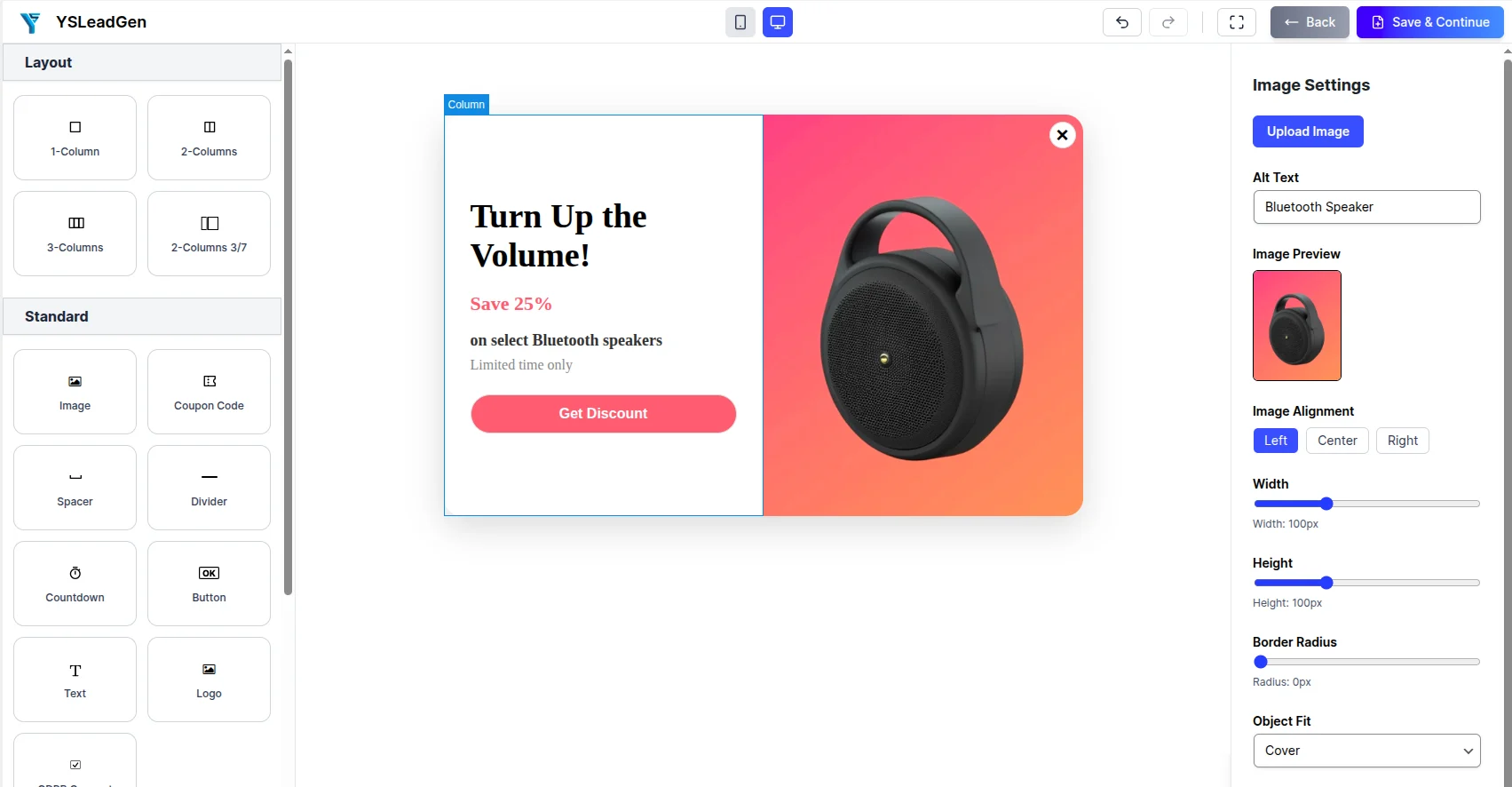
You can edit:
- Headlines
- Text content
- Images
- CTA buttons
- Background colors
- Typography
- Form fields
- Countdown timer settings
Example popup headlines:
- “Hurry! This Offer Expires Soon”
- “Don’t Miss This Limited-Time Deal”
- “Subscribe & Unlock Exclusive Savings”
Your popup should clearly explain:
- What the offer is
- Why users should take action
- What benefit they receive
Configure the Countdown Timer Block
If you added a countdown timer to your popup, configure the timer settings:
- Set the timer duration (e.g., 10 minutes, 1 hour, or a specific end date)
- Choose the timer style (digits, minimal, or colorful)
- Customize timer colors to match your brand
- Add a label below the timer (e.g., “Offer Expires In:”)
A well-configured countdown timer creates urgency and encourages visitors to act immediately.
Best Practices for Popup Design
A high-converting Slide In Popup should:
- Use short and clear text
- Include a strong CTA button
- Focus on one offer
- Match your website branding
- Avoid excessive animations
Simple popup designs usually perform better than complicated layouts.
Add a Lead Capture Form
If your goal is lead generation, add a signup form to the popup.
You can collect:
- Name
- Email address
- Phone number
This helps businesses:
- Build email lists
- Generate leads
- Run email campaigns
- Improve customer engagement
Many businesses use Slide In Popups specifically for email marketing and subscriber growth.
Step 5 – Configure Popup Triggers
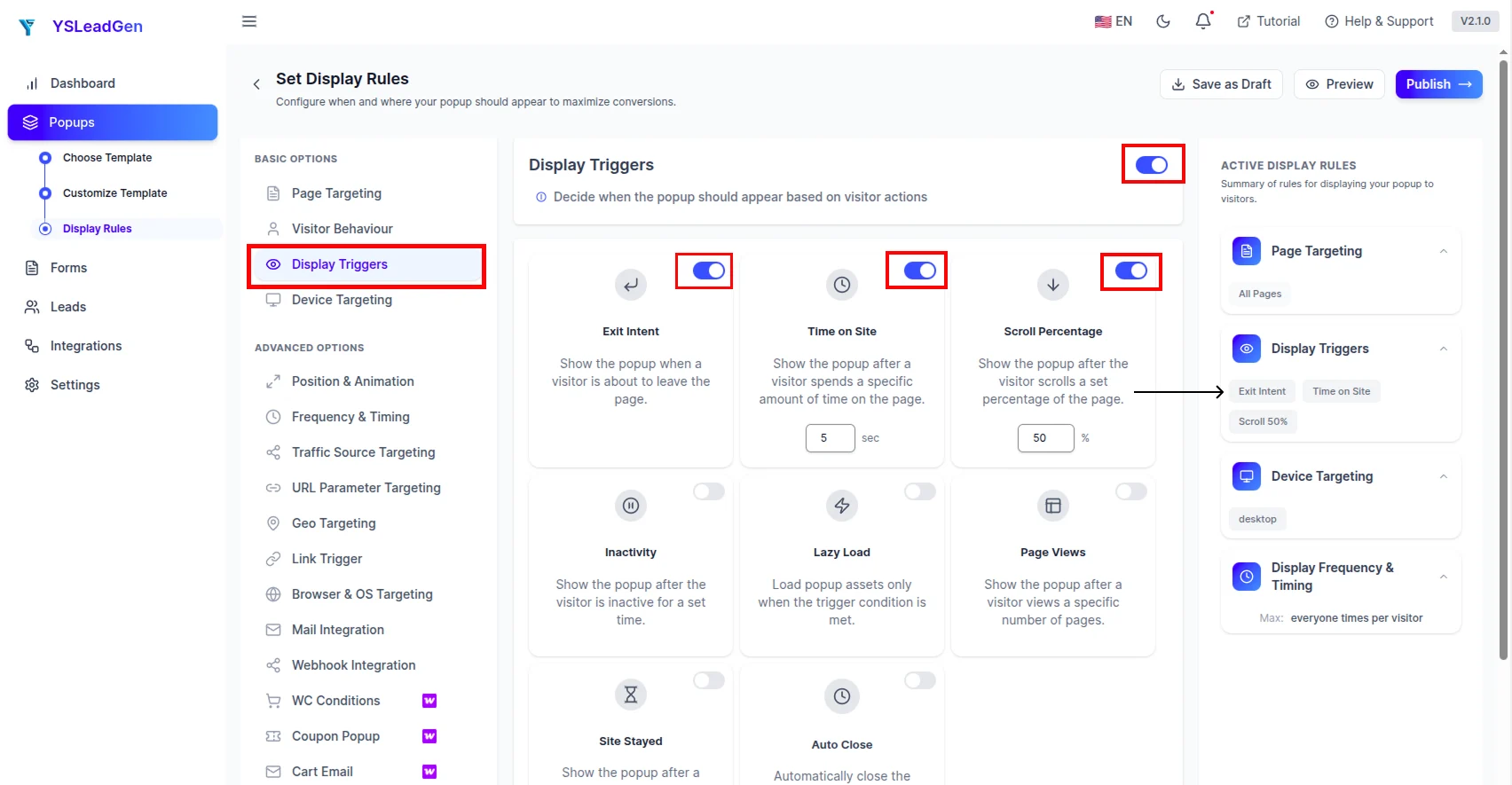
This step controls when your Slide In Popup appears to visitors.
Go to: Set Display Rules → Display Trigger
YS LeadGen supports multiple trigger options for Slide In Popups:
- Scroll Trigger – Popup appears after the visitor scrolls a defined percentage of the page
- Time Delay Trigger – Popup appears after the visitor spends a set amount of time on the page
- Exit Intent Trigger – Popup appears when the visitor is about to leave the page
- Click Trigger – Popup appears when a visitor clicks a specific button or link
For Slide In Popups, the most commonly used triggers are:
- Scroll Trigger (e.g., show popup after 50% scroll depth)
- Time Delay (e.g., show popup after 10 seconds on page)
Choose the trigger that best matches your campaign goal and visitor behavior.
Why Smart Triggers Matter
Traditional popups often appear immediately after page load and can negatively affect user experience.
Smart triggers improve popup performance because they display the popup:
- Only when visitors are engaged with your content
- At the right moment in the browsing journey
- Without disrupting early page exploration
This makes the Slide In Popup:
- Less intrusive
- More relevant
- More conversion-focused
Step 6 – Configure Display Rules
Now it’s time to configure where and when the popup should appear.
Display rules help you show targeted popups based on visitor behavior and page conditions.
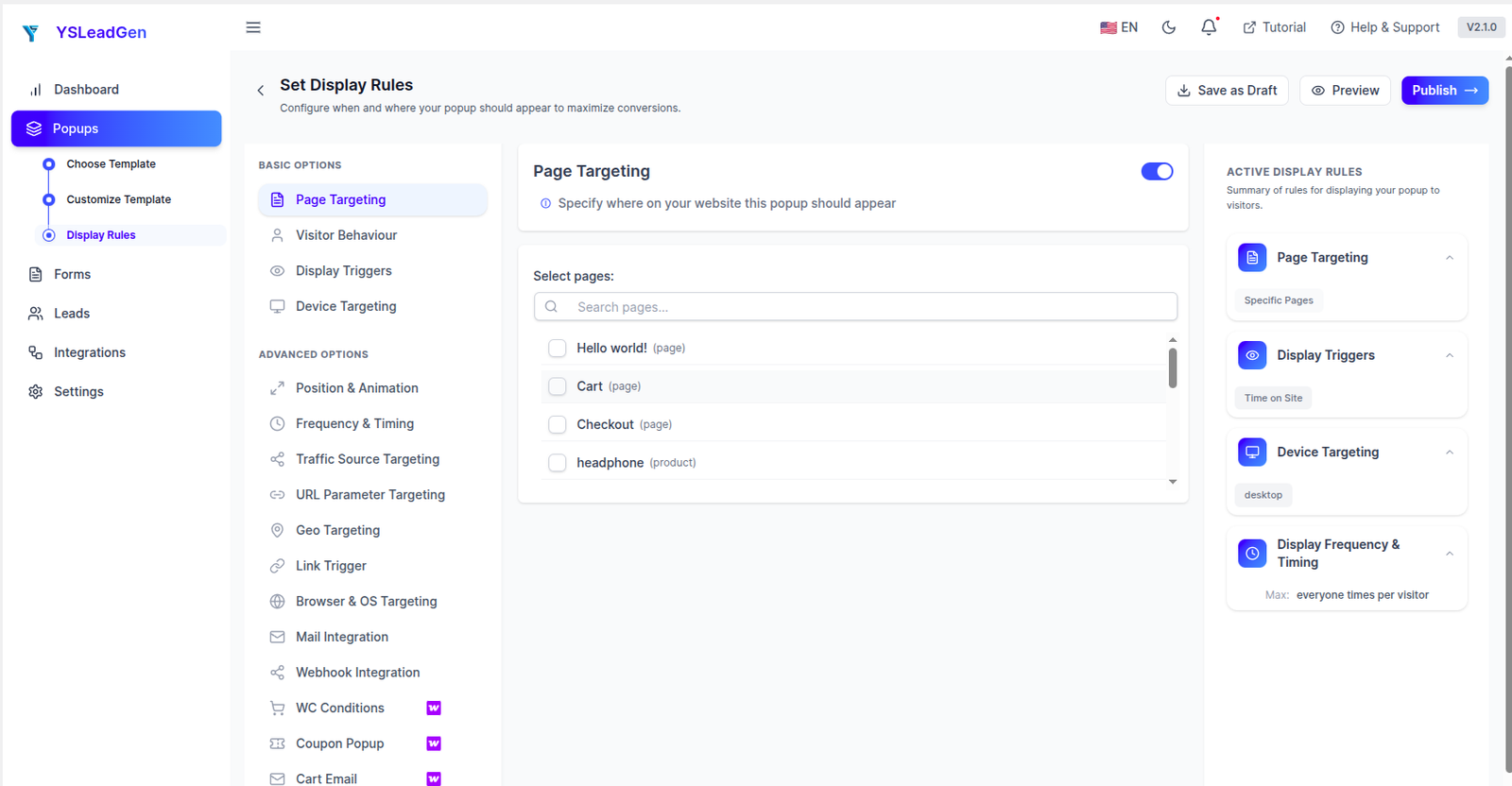
You can display the popup on:
- Entire website
- Homepage only
- Product pages
- Checkout pages
- Blog posts
- Landing pages
- Specific categories
Advanced targeting improves popup relevance and conversion opportunities.
Examples of Smart Popup Targeting
Different pages may require different popup strategies.
For example:
- Show countdown timer discount popups on WooCommerce product pages
- Show newsletter popups on blog articles
- Show free trial popups on SaaS pricing pages
- Show flash sale popups on homepage
Personalized popups generally perform much better than generic site-wide popups.
Configure Device Targeting
You can also choose where the popup appears based on device type.
Display popup on:
- Desktop devices
- Mobile devices
- Tablets
Responsive popup optimization is important because a large percentage of website traffic comes from mobile users.
Configure Popup Frequency
Avoid showing popups repeatedly to the same visitors.
Good popup frequency settings include:
- Show once per session
- Hide after signup
- Delay repeat display
This creates a better browsing experience and prevents popup fatigue.
Step 7 – Publish the Popup
Once everything is configured, it’s time to publish your Slide In Popup.
Click: Publish
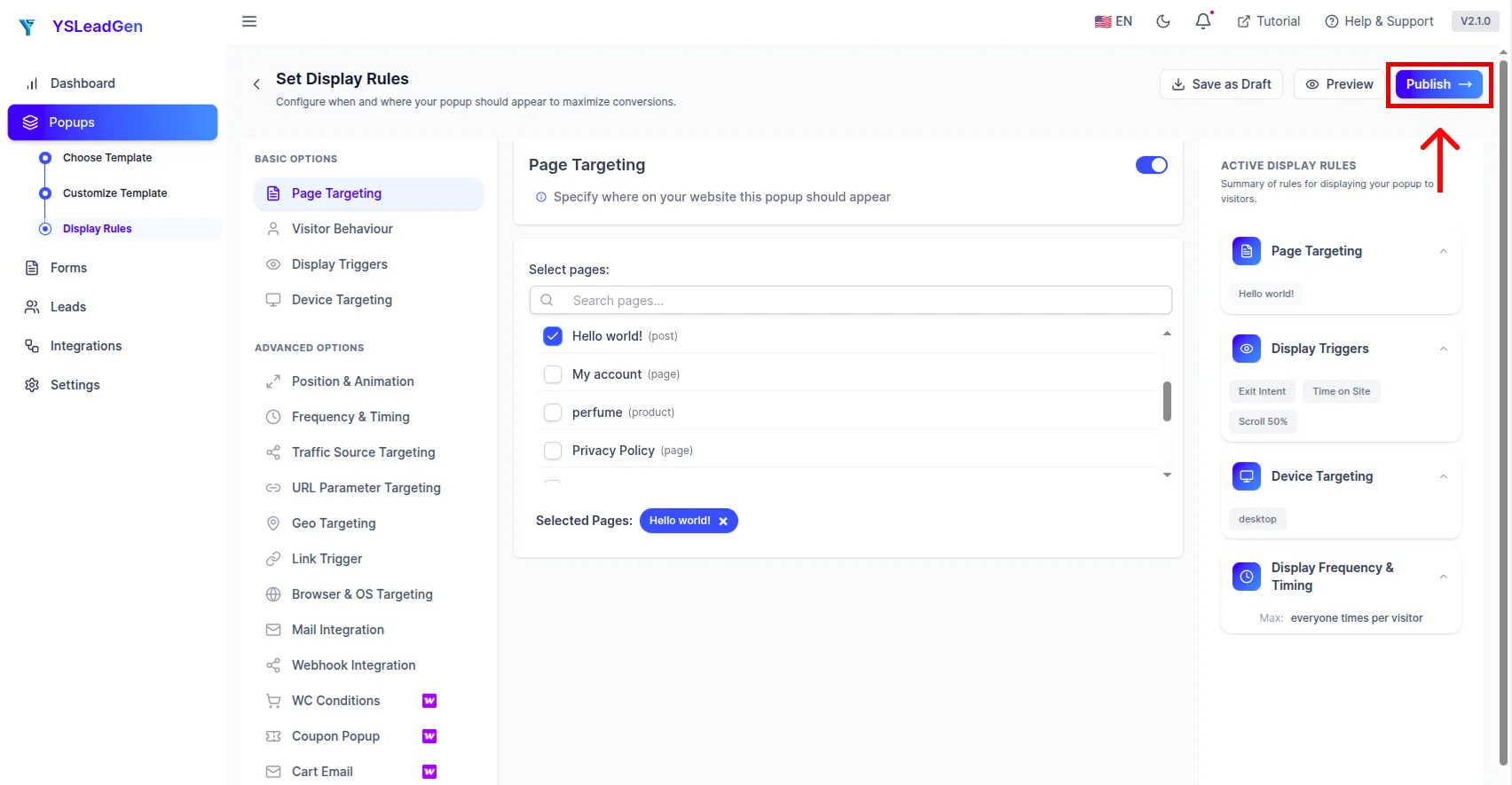
Your popup is now live on your WordPress website.
Visitors will automatically see the Slide In Popup based on the trigger and display rules you configured.
Test Your Slide In Popup
After publishing, test the popup manually to ensure everything works correctly.
Check:
- Popup slide-in animation
- Mobile responsiveness
- CTA button functionality
- Form submissions
- Countdown timer display and accuracy
- Trigger behavior
To test scroll trigger behavior:
- Visit the page where the popup is configured
- Scroll down the page to the defined scroll depth
- Verify that the popup slides in correctly
Testing helps avoid user experience issues after launch.
Tips to Improve Slide In Popup Conversions
To maximize popup performance:
- Use compelling headlines
- Offer real value
- Add a countdown timer for urgency
- Keep forms simple
- Use clear CTA buttons
- Optimize popup design for mobile users
Examples of strong CTA buttons:
- Get My Discount
- Claim Offer
- Subscribe Now
- Start Free Trial
- Grab This Deal
Small improvements can significantly increase popup conversion rates.
Best Practices for High-Converting Slide In Popups
Creating a Slide In Popup is easy, but creating a popup that actually converts visitors into subscribers, leads, and customers requires the right strategy.
Many website owners make common mistakes like:
- Showing popups too early
- Using weak offers
- Adding too much content
- Displaying generic messages
- Ignoring mobile optimization
- Forgetting to test countdown timers
As a result, visitors simply close the popup and leave the website.
To improve popup conversion rates, your Slide In Popup should be:
- Relevant
- Timely
- Simple
- Value-driven
- User-focused
Below are some of the most important best practices for creating high-converting Slide In Popups on your WordPress website.
1. Offer Something Valuable
Visitors need a reason to interact with your popup.
If your popup does not provide value, users are likely to ignore it.
Instead of generic messages like:
“Subscribe to Our Newsletter”
Offer something useful such as:
- Discount coupons
- Free shipping
- Free ebooks
- Exclusive deals
- Free consultations
- Early access offers
Example:
“Get 15% OFF Before This Deal Expires.”
The stronger the offer, the higher the chances of conversion.
2. Use a Countdown Timer to Create Urgency
One of the most powerful additions to any Slide In Popup is a countdown timer.
Countdown timers create a sense of urgency and FOMO (Fear of Missing Out), encouraging visitors to act immediately.
Use countdown timers for:
- Flash sale promotions
- Limited-time discount offers
- Product launch deals
- Seasonal campaigns
Example:
“This Offer Expires In:” [Countdown Timer] Claim My Discount
A countdown timer combined with a relevant offer can dramatically increase popup conversions.
3. Use a Strong and Clear Headline
Your popup headline is the first thing visitors notice.
A weak headline reduces engagement instantly.
Effective popup headlines should:
- Grab attention quickly
- Explain the offer clearly
- Create urgency or curiosity
Examples:
- “Wait! Don’t Miss This Offer”
- “Unlock 10% OFF – Limited Time Only”
- “This Deal Disappears Soon”
Clear and benefit-focused headlines improve popup click-through rates significantly.
4. Keep Popup Content Simple
One of the biggest popup mistakes is adding too much information.
Visitors usually decide within a few seconds whether to interact with the popup or close it.
Your popup should include:
- A short headline
- A brief description
- A countdown timer (if applicable)
- One clear CTA button
- Minimal form fields
Avoid:
- Long paragraphs
- Multiple offers
- Too many buttons
- Cluttered layouts
Simple popup designs often perform better than complicated designs.
5. Use a Strong Call-to-Action (CTA)
Your CTA button should clearly tell visitors what action to take.
Weak CTA examples:
- Submit
- Continue
- Click Here
Better CTA examples:
- Get My Discount
- Claim Offer
- Subscribe Now
- Start Free Trial
A strong CTA creates clarity and encourages immediate action.
6. Show the Popup at the Right Time
Timing plays a major role in popup performance.
Traditional popups often interrupt users too early and hurt user experience.
Slide In Popups work better because they can be configured to appear:
- After a visitor scrolls a portion of the page
- After the visitor spends time on the page
- When the visitor is about to leave
This makes them:
- Less intrusive
- More targeted
- More effective
Displaying the popup at the right moment improves both user engagement and conversion rates.
7. Optimize for Mobile Devices
A large percentage of website traffic now comes from mobile users.
Your Slide In Popup should be fully responsive on:
- Smartphones
- Tablets
- Desktop devices
Mobile-friendly popups should:
- Load quickly
- Fit smaller screens properly
- Use readable fonts
- Have easy-to-click buttons
Poor mobile optimization can negatively affect:
- User experience
- SEO performance
- Conversion rates
Always test your popup on different devices before publishing.
8. Use Targeted Display Rules
Not every visitor should see the same popup.
Smart popup targeting helps display more relevant offers based on:
- Pages visited
- User behavior
- Device type
- Cart activity
- Traffic source
Examples:
- Show countdown timer discount popups on product pages
- Show newsletter popups on blog posts
- Show free trial popups on pricing pages
Targeted popups usually generate better engagement and higher conversion rates.
9. Avoid Showing Popups Too Frequently
Repeated popups can frustrate visitors and increase bounce rates.
Configure popup frequency settings to:
- Show once per session
- Hide after conversion
- Delay repeat display
This creates a smoother browsing experience while still maximizing lead generation opportunities.
10. Test and Optimize Popup Performance
Even small popup improvements can increase conversions significantly.
Test different:
- Headlines
- CTA buttons
- Colors
- Popup layouts
- Offers
- Trigger timing
- Countdown timer durations
A/B testing helps identify which popup version performs best for your audience.
Continuous optimization is important for improving long-term popup performance.
Common Mistakes to Avoid
Slide In Popups can improve lead generation, email subscriptions, and WooCommerce sales when implemented correctly. However, many website owners make mistakes that reduce popup performance and negatively affect user experience.
One of the most common mistakes is showing popups too early. Visitors should first have enough time to explore the website before seeing a popup. Slide In Popups work best when triggered after a visitor has scrolled through a portion of the page or spent time reading your content.
Another major mistake is using weak offers. Generic messages like:
“Subscribe to Our Newsletter”
usually generate lower conversions. Instead, businesses should offer something valuable such as discount coupons, free shipping, free guides, or exclusive deals — especially when combined with a countdown timer for urgency.
Adding too much content inside the popup is another common issue. Visitors prefer simple and clean popup designs with short headlines, clear descriptions, and one strong CTA button. Complicated layouts and long paragraphs can reduce engagement.
Many businesses also ignore mobile optimization. Since a large percentage of traffic comes from smartphones, your popup should be fully responsive and easy to use on mobile devices.
Another mistake is displaying the same popup to every visitor. Smart targeting based on user behavior, product pages, blog pages, and device type can improve popup relevance and conversion rates significantly.
Neglecting to configure the countdown timer correctly is a common issue with time-sensitive campaigns. Ensure the countdown timer reflects an accurate end date or duration and that it resets properly based on your campaign settings.
Finally, many website owners fail to test and optimize popup campaigns. A/B testing different headlines, offers, countdown timer styles, and CTA buttons can help identify which popup performs best.
Avoiding these mistakes can help you create more effective Slide In Popups that improve user engagement and increase conversions.
Conclusion
Slide In Popups are one of the most effective and user-friendly ways to engage visitors and improve website conversions — without disrupting the browsing experience.
Instead of losing potential customers, businesses can use Slide In Popups to engage users at the right moment with:
- Discount offers
- Countdown timer promotions
- Newsletter signup forms
- Free trials
- Promotional campaigns
- Lead generation offers
Whether you run a WooCommerce store, SaaS website, business site, or blog, Slide In Popups can help:
- Increase email subscribers
- Reduce bounce rates
- Generate more leads
- Improve customer engagement
- Boost website conversion rates
The best part is that creating a Slide In Popup in WordPress is simple and beginner-friendly.
Using popup builder plugins like YS LeadGen, you can quickly create professional Slide In Popups with ready-made countdown timer templates, smart display rules, and advanced popup triggers — without coding knowledge.
By following the strategies and best practices shared in this guide, you can create high-converting Slide In Popups that turn passive visitors into subscribers, leads, and paying customers.
Frequently Asked Questions (FAQs)
How is a Slide In Popup different from a regular popup?
Unlike traditional full-screen popups that block all page content, Slide In Popups appear only in a corner of the screen. This makes them less disruptive and more user-friendly while still promoting offers effectively.
Can I add a countdown timer to a Slide In Popup?
Yes. Using YS LeadGen, you can either choose a pre-built countdown timer popup template or add a Countdown block directly inside the popup editor when building from scratch. Countdown timers are perfect for flash sales, limited-time discounts, and promotional campaigns.
Do Slide In Popups work on mobile devices?
Yes. Modern WordPress popup plugins support responsive popup designs that work across mobile, tablet, and desktop devices.
Can Slide In Popups increase WooCommerce sales?
Yes. Slide In Popups can help promote discount offers, countdown timer flash sales, and free shipping deals to visitors browsing your WooCommerce product pages — encouraging them to complete their purchase.
Are Slide In Popups bad for SEO?
No. When implemented correctly, Slide In Popups do not negatively affect SEO. In fact, since they don't block the main page content, they are generally considered more SEO-friendly than full-screen interstitial popups.
What is the best WordPress Slide In Popup plugin?
YS LeadGen is a beginner-friendly WordPress popup plugin that helps create Slide In Popups, countdown timer promotions, lead generation forms, and WooCommerce promotional popups easily.
Can I create a Slide In Popup without coding?
Yes. Using WordPress popup builder plugins like YS LeadGen, you can create professional Slide In Popups without any coding knowledge.
What types of offers work best in Slide In Popups?
High-converting offers include:
- Discount coupons
- Countdown timer flash sale deals
- Free shipping
- Newsletter subscriptions
- Free trials
- Lead magnets
- Limited-time promotions
What triggers can I use for a Slide In Popup?
YS LeadGen supports multiple triggers including scroll depth, time delay, exit intent, and click triggers. For Slide In Popups, scroll and time delay triggers are most commonly used to engage visitors who are already engaged with the page content.
About the author

YSLeadGen Pro - Lifetime Deal
Access to unlimited popups, advanced targeting, event triggers, and premium templates.
14-Days Risk Free Money Back Guarantee