- What Is a Lead?
- Why Is Lead Generation Important?
- How Lead Generation Works
- Types of Leads Explained
- Best Lead Generation Channels
- Website Lead Generation Strategies That Work
- Common Lead Generation Mistakes
- How to Measure Lead Generation Success
- Lead Generation Tools Every Business Should Know
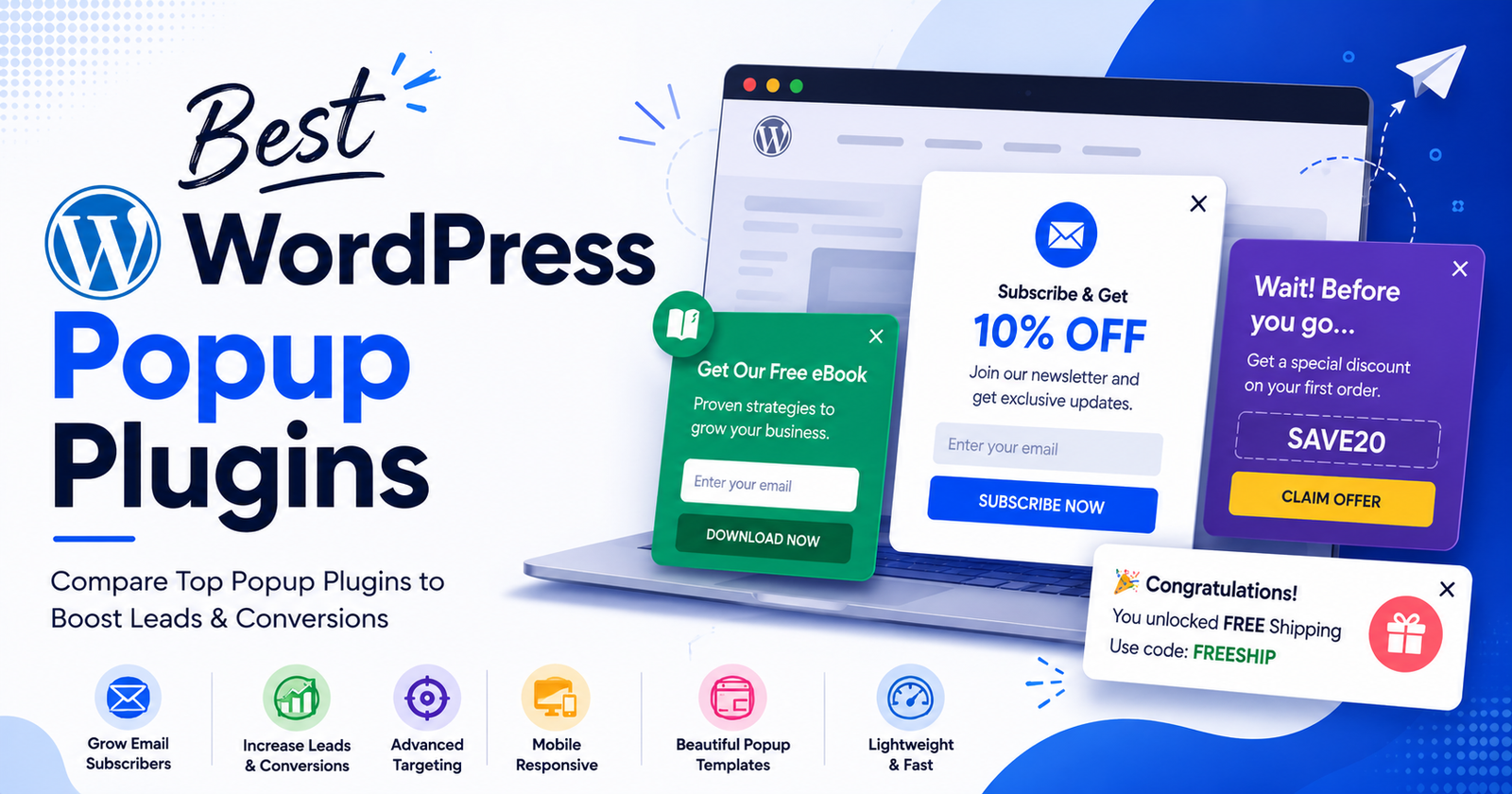
- Why Website Popups Are Effective for Lead Generation
- How YS LeadGen Helps Generate More Leads
- Final Thoughts
- Frequently Asked Questions
What Is Lead Generation? A Beginner’s Guide to Getting More Customers Online

- What Is a Lead?
- Why Is Lead Generation Important?
- How Lead Generation Works
- Types of Leads Explained
- Best Lead Generation Channels
- Website Lead Generation Strategies That Work
- Common Lead Generation Mistakes
- How to Measure Lead Generation Success
- Lead Generation Tools Every Business Should Know
- Why Website Popups Are Effective for Lead Generation
- How YS LeadGen Helps Generate More Leads
- Final Thoughts
- Frequently Asked Questions
You launch a website.
You invest time creating content, improving your SEO, sharing posts on social media, and maybe even running a few advertising campaigns. Slowly, visitors start arriving. People read your blog posts, browse your products, and explore your services.
Everything seems to be moving in the right direction.
Then they leave.
No inquiry. No signup. No purchase.
For many businesses, this is one of the most frustrating parts of running a website. Traffic alone doesn’t grow a business. What matters is turning that traffic into potential customers.
This is where lead generation comes in.
Lead generation helps businesses identify visitors who are interested in their products or services and gives them a way to continue the conversation. Instead of losing visitors forever, you collect information that allows you to build relationships, provide value, and eventually convert those prospects into customers.
Whether you’re running a blog, an ecommerce store, a SaaS product, a local business, or a digital agency, lead generation plays a critical role in long-term growth.
In this guide, you’ll learn what lead generation is, why it’s important, how it works, and the most effective strategies businesses use to generate leads online.
What Is Lead Generation?
At its core, lead generation is the process of attracting potential customers and collecting their contact information so you can continue engaging with them.
A potential customer becomes a lead when they show interest in your business.
That interest can take many forms.
Someone might:
- Subscribe to your email newsletter
- Download a free guide
- Request a product demo
- Fill out a contact form
- Register for a webinar
- Start a free trial
Each of these actions indicates that the visitor is interested enough to take the next step.
Think about it this way.
If someone visits your website and leaves without taking any action, there’s very little you can do after they disappear.
But if they provide their email address or contact details, you now have an opportunity to build a relationship with them.
You can educate them, answer questions, showcase your expertise, and guide them toward becoming a customer.
That’s the purpose of lead generation.
It’s not simply about collecting names and email addresses. It’s about creating opportunities for future conversations.
What Is a Lead?
Before going further, it’s important to understand what a lead actually is.
A lead is a person who has shown interest in your business, product, or service.
The key word here is “interest.”
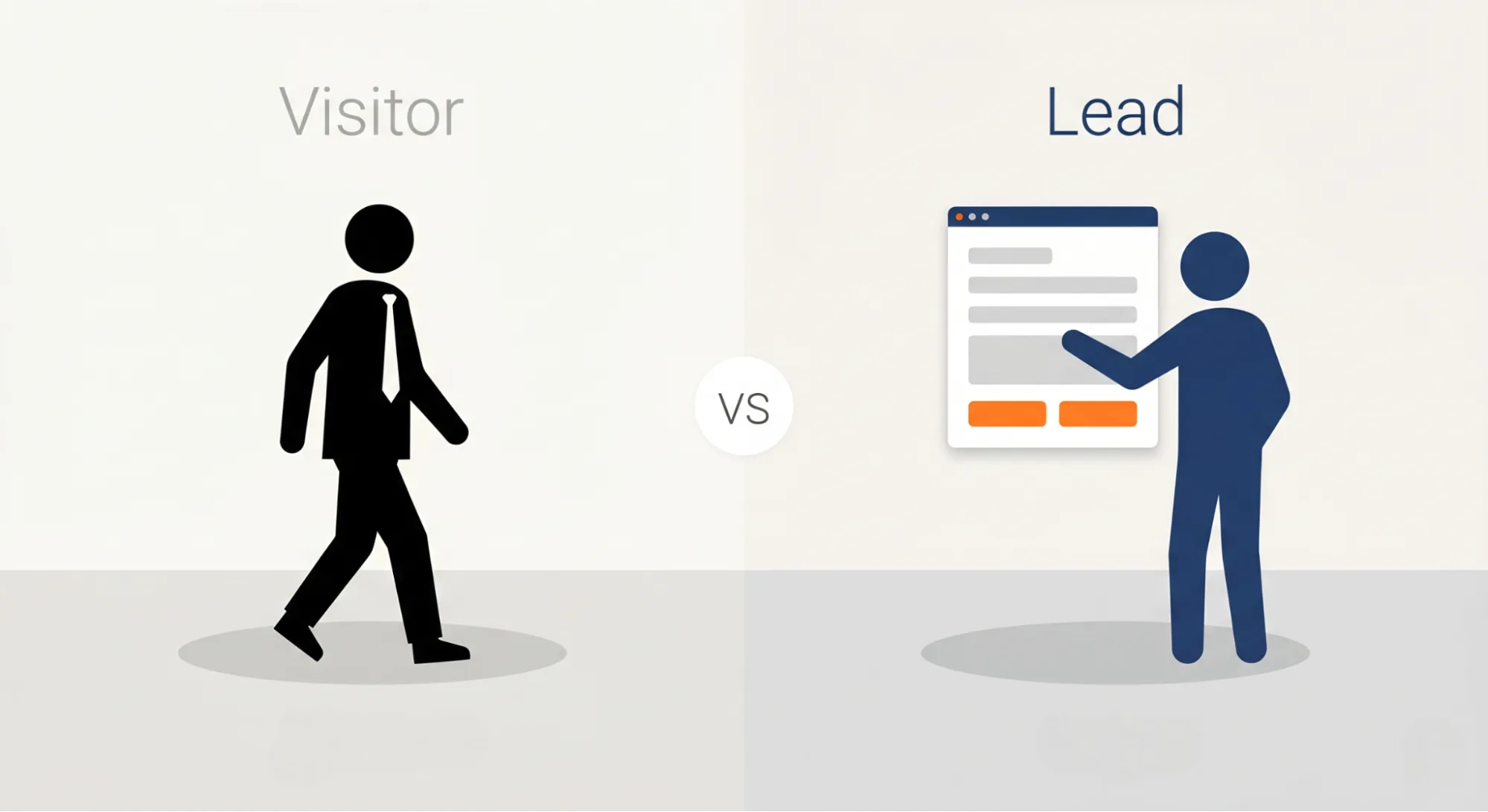
Not everyone who visits your website is a lead.
Someone becomes a lead when they take an action that indicates they want to learn more about what you offer.
For example, imagine you run a web design agency.
A visitor reads one of your blog posts and leaves without interacting further.
That person is a visitor.
Now imagine another visitor downloads your website redesign checklist and provides their email address.
That person is a lead.
They’ve shown interest and given you a way to continue the conversation.
The same concept applies across different industries.
For an ecommerce store, a lead might be someone who joins an email list to receive discounts.
For a SaaS company, a lead might be someone who starts a free trial.
For a consultant, a lead could be someone who requests a discovery call.
The exact action varies, but the principle remains the same.
A lead is someone who has moved beyond casual browsing and demonstrated interest in your business.

Why Is Lead Generation Important?
Many business owners focus heavily on traffic.
They spend months improving rankings, creating content, and driving visitors to their websites.
While traffic is important, traffic alone doesn’t generate revenue.
Imagine two websites.
The first website receives 100,000 visitors every month but collects very few leads.
The second website receives 20,000 visitors each month but has an effective lead generation strategy.
Which website is likely to produce more customers?
In many cases, the second one.
That’s because lead generation helps businesses make the most of the traffic they’re already receiving.
Visitors Rarely Buy Immediately
One of the biggest misconceptions in online marketing is that visitors arrive ready to purchase.
In reality, most people need time before making a decision.
They want to:
- Research solutions
- Compare alternatives
- Read reviews
- Understand pricing
- Evaluate trustworthiness
Lead generation helps bridge this gap.
Instead of expecting visitors to become customers immediately, you give them a way to stay connected with your business while they continue evaluating their options.
Lead Generation Creates Future Opportunities
A visitor who leaves your website is often gone forever.
A lead, however, creates future opportunities.
You can:
- Send educational content
- Share product updates
- Offer promotions
- Invite them to webinars
- Provide case studies
- Build trust over time
This ongoing communication dramatically increases the chances of turning a prospect into a customer.
It Makes Marketing More Predictable
Businesses that rely solely on immediate sales often experience unpredictable growth.
Lead generation creates a pipeline of potential customers.
Instead of constantly chasing new visitors, you build a database of people who have already expressed interest in what you offer.
This makes future marketing efforts more effective and more predictable.
How Lead Generation Works
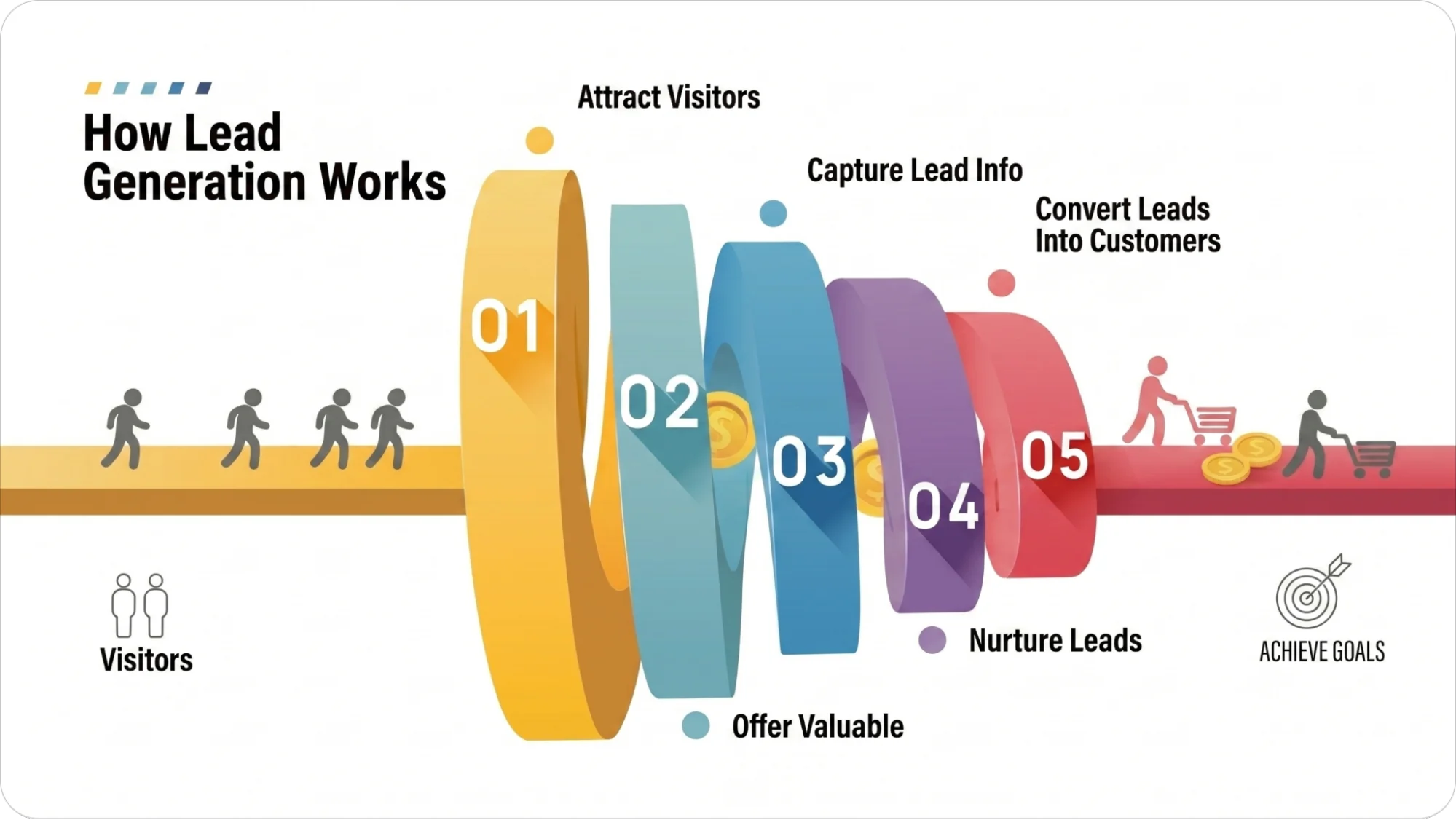
Lead generation is often described as a funnel.
At the top of the funnel, people discover your business.
As they move through the funnel, some of them become leads.
Eventually, a portion of those leads become customers.
Let’s break the process down.
Step 1: Attract Visitors
Everything begins with traffic.
People need to discover your business before they can become leads.
Common traffic sources include:
- Search engine optimization (SEO)
- Social media marketing
- Paid advertising
- YouTube
- Referral traffic
- Online communities
The goal at this stage is visibility.
You want potential customers to find your website when they’re searching for solutions.
Step 2: Offer Something Valuable
Once visitors arrive, you need to give them a reason to engage.
This is where many businesses struggle.
Simply asking for contact information rarely works.
People are more likely to share their details when they receive something valuable in return.
Examples include:
- Free guides
- Checklists
- Templates
- Discounts
- Free consultations
- Webinars
The stronger the value proposition, the more likely visitors are to become leads.
Step 3: Capture Lead Information
This is where lead generation tools come into play.
Businesses use:
- Lead capture forms
- Contact forms
- Landing pages
- Newsletter forms
- Exit-intent popups
- Multi-step forms
The goal is to make it easy for visitors to express interest.
Step 4: Nurture Leads
Not every lead is ready to buy immediately.
Many need additional information before making a decision.
Lead nurturing helps move prospects closer to becoming customers.
This often involves:
- Email marketing
- Educational content
- Product demonstrations
- Case studies
- Personalized follow-ups
The purpose is to continue providing value while building trust.
Step 5: Convert Leads Into Customers
Eventually, some leads become paying customers.
This is where the efforts invested in attracting, capturing, and nurturing leads begin to pay off.
Businesses with strong lead generation systems often find it easier to generate consistent sales because they aren’t relying entirely on immediate purchases.
They’ve built a process that guides prospects from initial interest to final conversion.
Types of Leads Explained
Not all leads are the same.
Some people are just starting to learn about a problem. Others are actively comparing solutions. A few may already be ready to make a purchase.
Understanding the different types of leads helps businesses prioritize their efforts and communicate more effectively with potential customers.
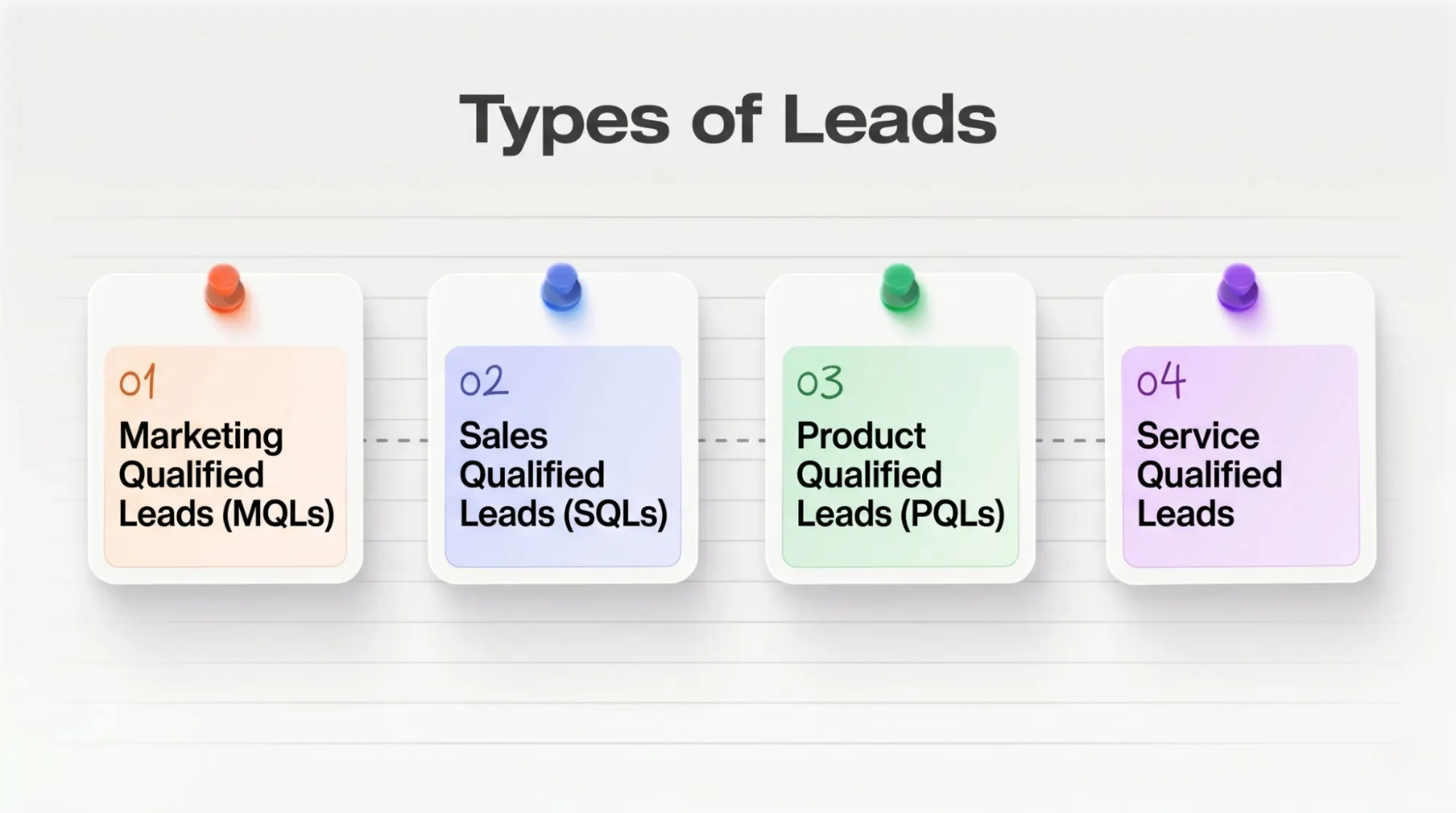
Marketing Qualified Leads (MQLs)
A Marketing Qualified Lead is someone who has shown interest in your business but isn’t necessarily ready to buy.
For example, someone who:
- Downloads an ebook
- Subscribes to your newsletter
- Registers for a webinar
- Downloads a free template
These individuals are interested in your content and want to learn more, but they may still be researching solutions.
The goal at this stage is education rather than selling.
Sales Qualified Leads (SQLs)
Sales Qualified Leads are further along in the buying journey.
They’ve moved beyond general interest and are actively evaluating solutions.
Examples include people who:
- Request a demo
- Contact your sales team
- Ask about pricing
- Request a consultation
These leads typically require more direct communication because they are closer to making a purchase decision.
Product Qualified Leads (PQLs)
Product Qualified Leads are common in SaaS businesses.
These are people who have already experienced the product through a free trial or freemium version.
Because they’ve interacted with the product directly, they often have a stronger understanding of its value.
For many software companies, PQLs are among the highest-converting lead types.
Service Qualified Leads
Service Qualified Leads are individuals who express interest in working directly with your business.
Examples include:
- Agency consultation requests
- Coaching inquiries
- Service quote requests
- Discovery call bookings
These leads are often highly valuable because they’ve already indicated a desire to discuss a specific service.
Best Lead Generation Channels
One of the most common questions beginners ask is:
“Where do leads come from?”
The answer depends on your business model, audience, and marketing strategy.
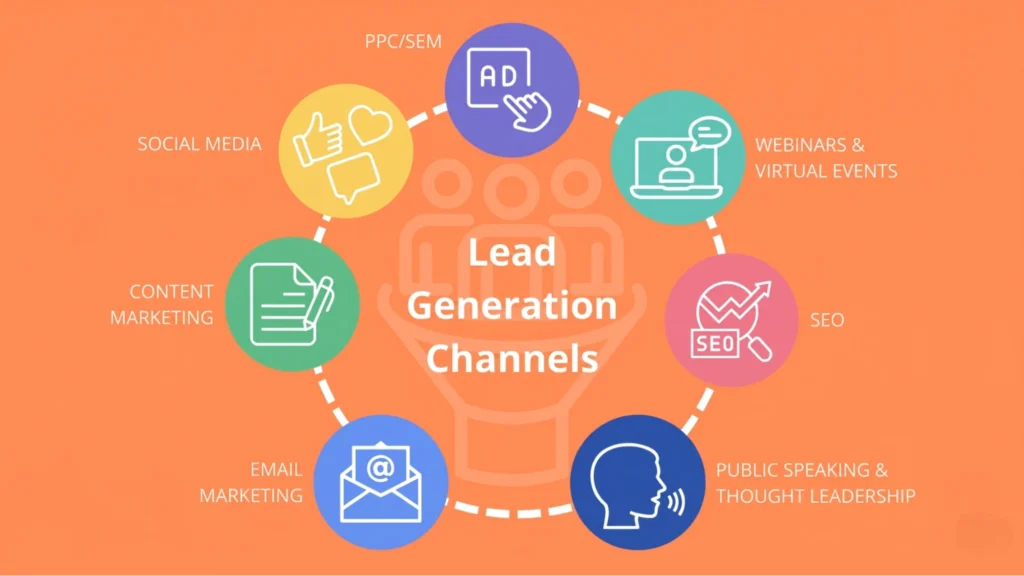
However, most successful businesses generate leads through a combination of channels rather than relying on a single source.
Search Engine Optimization (SEO)
SEO remains one of the most effective lead generation channels because it allows businesses to attract people who are actively searching for information, products, or services.
For example:
Someone searching for:
- “Best email marketing software”
- “WordPress popup plugin”
- “How to generate leads online”
is already demonstrating interest in a specific topic.
By creating valuable content around those searches, businesses can attract highly relevant visitors and convert them into leads.
One of the biggest advantages of SEO is sustainability.
Unlike paid advertising, organic traffic can continue generating leads long after content is published.
Content Marketing
Content marketing and lead generation go hand in hand.
When businesses publish helpful content, they attract visitors who are looking for solutions.
Blog posts, guides, videos, case studies, and tutorials all create opportunities to educate potential customers while generating leads.
For example:
A blog post about improving website conversions could offer a free conversion optimization checklist.
Visitors receive value, and the business captures a lead.
Email Marketing
Email marketing is often viewed as a nurturing channel, but it can also support lead generation.
Referral programs, newsletter promotions, and content sharing can help attract new prospects while maintaining relationships with existing leads.
Social Media Marketing
Social media platforms help businesses expand their reach and connect with potential customers.
Whether you’re posting educational content on LinkedIn, sharing tips on Instagram, or engaging in discussions on Facebook, social media can be a valuable source of leads when combined with strong offers and clear calls to action.
Paid Advertising
Paid advertising provides a faster way to generate leads by placing offers directly in front of targeted audiences.
Businesses commonly use:
- Google Ads
- Facebook Ads
- Instagram Ads
- LinkedIn Ads
- YouTube Ads
The key to success is ensuring that the traffic is directed toward a compelling offer rather than a generic homepage.
Website Popups
Many website owners focus entirely on generating more traffic while overlooking the visitors they already have.
This is where website popups become valuable.
A visitor may spend several minutes reading content, browsing products, or exploring services before leaving.
Without a lead generation strategy, that visitor disappears.
A targeted popup provides an opportunity to capture their interest before they leave.
For example:
- Offer a free guide
- Provide a discount
- Invite them to join a newsletter
- Promote a consultation
Website popups help convert existing traffic into leads without requiring additional marketing spend.

Website Lead Generation Strategies That Work
Lead generation doesn’t happen by accident.
Successful businesses intentionally create opportunities for visitors to engage and share their information.
Let’s look at some of the most effective strategies.
Create Valuable Lead Magnets
A lead magnet is something valuable offered in exchange for contact information.
Examples include:
- Checklists
- Templates
- Guides
- Toolkits
- Case studies
- Free resources
The best lead magnets solve a specific problem.
Instead of creating a generic ebook, focus on something practical and actionable.
The more valuable the resource, the more likely visitors are to become leads.
Use Email Signup Forms
Email signup forms remain one of the simplest lead generation tools available.
However, successful signup forms focus on benefits rather than features.
Compare these two examples:
Join Our Newsletter
vs
Get Weekly Marketing Tips That Help You Generate More Leads
The second option clearly communicates value.
Visitors understand what they’ll receive and why it matters.
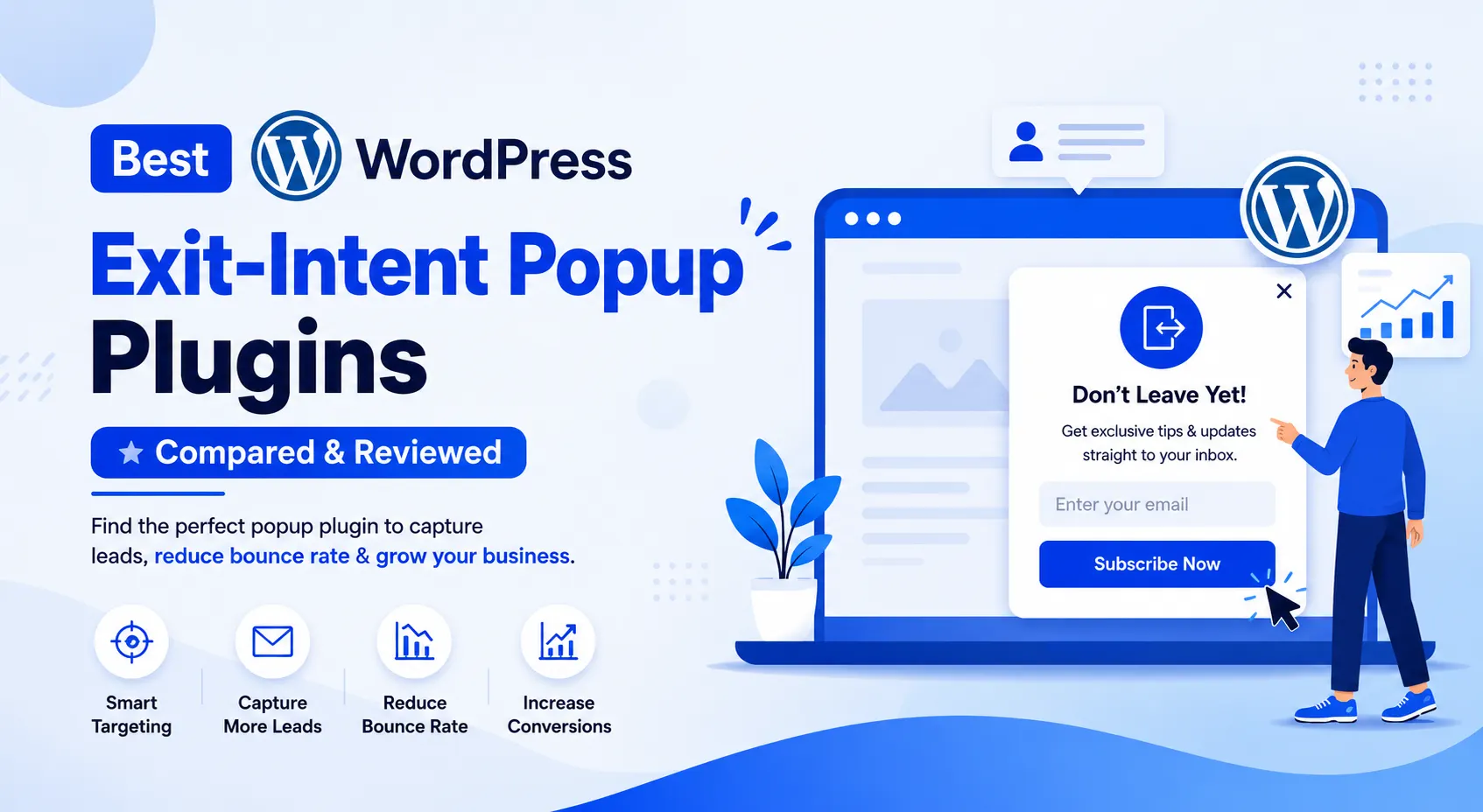
Add Exit-Intent Popups
Many visitors leave websites without taking any action.
Exit-intent popups create one final opportunity to engage them.
Imagine a visitor reading a blog post about lead generation.
As they’re about to leave, a popup appears:
Download Our Free Lead Generation Checklist Before You Go
This simple interaction can transform an anonymous visitor into a qualified lead.
Create Dedicated Landing Pages
Landing pages focus on a single offer.
Unlike a homepage, which serves multiple purposes, a landing page is designed around one goal.
For example:
- Download a guide
- Request a demo
- Register for a webinar
- Book a consultation
Removing distractions often improves conversion rates.
Offer Free Consultations
Service-based businesses can generate highly qualified leads by offering consultations.
Visitors receive personalized advice, while businesses gain an opportunity to demonstrate expertise.
This strategy works particularly well for:
- Agencies
- Consultants
- Coaches
- Professional services
Optimize Calls-to-Action
A strong call-to-action can dramatically impact lead generation performance.
Instead of generic buttons such as:
- Submit
- Send
- Continue
Use more specific language:
- Download My Guide
- Get My Free Audit
- Start My Free Trial
Clear and benefit-driven CTAs encourage action.
Use Social Proof
People are more likely to trust businesses that others already trust.
Social proof can include:
- Testimonials
- Reviews
- Customer success stories
- User counts
- Case studies
Trust plays a major role in lead generation, especially when visitors are considering sharing personal information.

Common Lead Generation Mistakes
Lead generation is powerful, but it’s easy to make mistakes that reduce results.
One of the most common mistakes is asking for too much information too soon.
A visitor who is downloading a simple checklist doesn’t necessarily want to provide:
- Phone number
- Company size
- Job title
- Budget details
Every additional field creates friction.
Another common mistake is creating weak offers.
Visitors won’t exchange their information unless they believe the offer is valuable.
Businesses also frequently neglect mobile users.
Forms that work perfectly on desktop devices may create frustration on smartphones.
Finally, many businesses focus entirely on generating leads and forget about nurturing them.
Capturing a lead is only the beginning.
Without follow-up communication, many leads never become customers.
How to Measure Lead Generation Success
Generating leads is important, but collecting contact information alone doesn’t guarantee business growth.
To understand whether your lead generation efforts are working, you need to measure the right metrics.
Many beginners focus only on the number of leads they collect. While that number matters, it doesn’t tell the full story.
For example, would you rather have:
- 1,000 low-quality leads who never respond
or
- 100 highly qualified leads who are genuinely interested in your product or service?
Most businesses would choose the second option.
That’s why lead quality is just as important as lead quantity.
Number of Leads Generated
This is the most basic lead generation metric.
It measures how many leads your website, campaigns, or marketing channels generate within a specific period.
Tracking lead volume helps you understand whether your traffic and campaigns are creating opportunities for future sales.
Conversion Rate
Your conversion rate shows how effectively you’re turning visitors into leads.
A simple way to calculate it is:
\text{Conversion Rate}=\frac{\text{Leads}}{\text{Visitors}}\times100
For example:
If your website receives 10,000 visitors and generates 300 leads, your conversion rate is 3%.
Improving conversion rates is often more profitable than simply trying to increase traffic.
Lead Quality
Not every lead has the same value.
A qualified lead who matches your ideal customer profile is typically more valuable than several unqualified leads.
Businesses should regularly evaluate:
- Lead relevance
- Purchase intent
- Engagement levels
- Conversion potential
This helps ensure marketing efforts attract the right audience.
Cost Per Lead (CPL)
For businesses running paid campaigns, understanding acquisition costs is essential.
Cost Per Lead measures how much you spend to generate each lead.
Lower acquisition costs often improve overall marketing profitability.
Revenue Generated
Ultimately, lead generation should contribute to business growth.
Tracking how many leads become customers helps you understand which channels and campaigns generate the highest return on investment.
Lead Generation Tools Every Business Should Know
Lead generation becomes much easier when you have the right tools.
Different businesses use different technology stacks, but most successful lead generation systems include several key components.
Customer Relationship Management (CRM) Software
A CRM helps businesses organize and manage leads throughout the customer journey.
Instead of storing information in spreadsheets, a CRM centralizes lead data and communication history.
Popular CRM functions include:
- Contact management
- Lead tracking
- Follow-up reminders
- Sales pipeline management
Email Marketing Platforms
Email remains one of the most effective lead nurturing channels.
Email marketing platforms allow businesses to:
- Send newsletters
- Create automated sequences
- Deliver lead magnets
- Nurture prospects
Once a visitor becomes a lead, email often becomes the primary communication channel.
Analytics Tools
Analytics tools help businesses understand how visitors interact with their websites.
By monitoring visitor behavior, businesses can identify:
- High-performing pages
- Traffic sources
- Conversion opportunities
- Areas needing improvement
Without analytics, optimization becomes difficult.
Landing Page Builders
Landing pages are designed to convert visitors into leads.
Dedicated landing page tools make it easier to create focused campaigns without requiring extensive technical knowledge.
Popup Builders
Popup builders play an important role in website lead generation.
Many visitors leave websites without filling out forms or contacting businesses.
Strategically placed popups create additional opportunities to engage those visitors before they leave.
This is especially useful for:
- Growing email lists
- Promoting lead magnets
- Offering discounts
- Booking consultations
- Generating inquiries

Why Website Popups Are Effective for Lead Generation
Some people assume popups are annoying.
The reality is that poorly designed popups are annoying.
Relevant popups that provide value can be highly effective.
Imagine a visitor reading a detailed article about lead generation strategies.
They’ve spent several minutes consuming your content and clearly find the topic valuable.
At that moment, offering a free lead generation checklist or downloadable guide feels helpful rather than intrusive.
The key is timing and relevance.
Successful lead generation popups typically focus on:
- Solving a problem
- Offering immediate value
- Reducing friction
- Presenting clear benefits
When used correctly, popups can significantly increase the number of leads generated from existing website traffic.
How YS LeadGen Helps Generate More Leads
If your goal is to generate more leads from your WordPress website, having the right tools can make a significant difference.
YS LeadGen is designed to help businesses capture more leads by creating targeted popup campaigns and lead capture forms.
Instead of watching visitors leave without taking action, you can create opportunities for engagement throughout the customer journey.
For example, you can use YS LeadGen to:
Build Email Signup Popups
Grow your subscriber list by encouraging visitors to join your newsletter or receive exclusive content.
Create Lead Magnet Campaigns
Offer guides, checklists, templates, or other resources in exchange for contact information.
Launch Exit-Intent Popups
Engage visitors who are about to leave your website and encourage them to stay connected.
Create Promotional Campaigns
Promote discounts, consultations, free trials, or limited-time offers.
Generate More Leads Without Coding
Because YS LeadGen integrates directly with WordPress, businesses can create lead generation campaigns without hiring developers or managing complex technical setups.
The goal isn’t simply to collect more leads.
It’s to create meaningful opportunities to start conversations with potential customers.
Final Thoughts
Lead generation is one of the most important activities for any online business.
Whether you’re running a blog, an ecommerce store, a SaaS product, a local business, or a digital agency, success ultimately depends on your ability to attract interested prospects and turn them into customers.
The challenge is that most website visitors won’t buy immediately.
They need time to learn, compare options, and build trust.
Lead generation bridges that gap.
By capturing contact information and continuing the conversation, businesses create more opportunities to educate, nurture, and convert potential customers over time.
The good news is that you don’t need a complicated system to get started.
A valuable offer, a clear lead capture form, and a simple follow-up process can go a long way toward building a reliable lead generation engine.
As your business grows, you can expand your efforts through content marketing, SEO, email campaigns, landing pages, and targeted popup campaigns.
The important thing is to start.
Because every visitor who leaves without taking action is a missed opportunity—and every lead you capture creates the potential for future growth.
Ready to Generate More Leads From Your Website?
If you’re looking for an easy way to turn more website visitors into subscribers, prospects, and customers, YS LeadGen helps you create high-converting popups and lead capture campaigns directly inside WordPress.
Start capturing more leads and make the most of the traffic you’re already receiving.
Frequently Asked Questions
What Is an Example of a Lead?
A person who downloads a free guide, subscribes to a newsletter, requests a demo, or fills out a contact form is considered a lead.
Why Is Lead Generation Important?
Lead generation helps businesses build relationships with potential customers, increase sales opportunities, and create a predictable growth pipeline.
What Are the Best Lead Generation Strategies?
Some of the most effective strategies include:
- SEO
- Content marketing
- Email marketing
- Lead magnets
- Landing pages
- Website popups
- Free consultations
How Do Websites Generate Leads?
Websites typically generate leads through forms, landing pages, newsletter subscriptions, free resources, consultation requests, and popup campaigns.
Are Popups Effective for Lead Generation?
Yes. When they provide value and appear at the right time, popups can help convert visitors into leads without requiring additional traffic.
About the author

YSLeadGen Pro - Lifetime Deal
Access to unlimited popups, advanced targeting, event triggers, and premium templates.
14-Days Risk Free Money Back Guarantee